Check a Polish car’s history and condition. Review PCC conditions, 61 PLN temporary registration and Estonian tax and registration requirements before buying.
A Polish advert’s price becomes comparable only once you know the car’s history, present condition and the transaction’s tax treatment. Start with the registration number, vehicle identification number (VIN) and first-registration date: these let you run a free Historia Pojazdu check. Then compare the information with originals and on-site findings before paying a deposit. 1 3
This guide covers a private individual living in Estonia buying a used M1 passenger car with up to seven seats located in Poland. Conditions and prices were checked on 22 October 2026. Also ask the seller immediately for the advert link and confirmation of who will sign the contract.
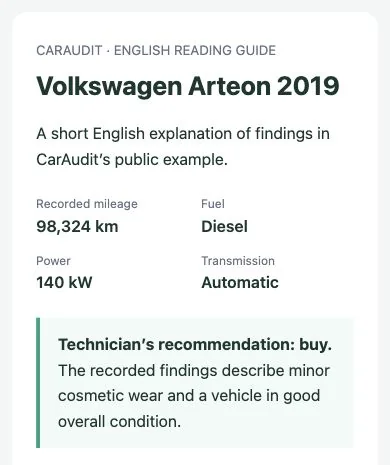
Editorial English reading guide to the official CarAudit sample report.
The original interface is English, and the technician’s notes are Spanish.
A history record becomes useful alongside the seller’s evidence
Historia Pojazdu is Poland’s official vehicle-history check. It may show registration, roadworthiness-test and compulsory motor liability insurance data, plus available foreign records. Mileage readings from roadworthiness tests have been collected since 2014. The downloadable PDF is an informative extract, rather than official legal evidence. A missing record does not establish the absence of damage or the car’s current technical condition. 1
Checking foreign risks for a car absent from Poland’s Central Vehicle Register (CEP) requires a Polish trusted profile, profil zaufany, and relies on available foreign data. Do not plan the purchase on the assumption that a foreign buyer will definitely be able to log in. Ask the seller for the check results and maintenance and repair invoices. 1
Match the VIN on the car, registration certificate and contract. Check the seller’s identity and ownership or authority to act; the chain of ownership must be demonstrable for registration. A clean register alone does not establish authority to sell, a complete history or condition. Estonia’s Transport Administration recommends thorough underbody and history checks. 2 3
See what CarAudit checks (Estonian). 4 The published vehicle-location countries for standard inspection are Poland, Austria, Belgium, Czechia, Germany, France, Italy, Luxembourg, the Netherlands, Romania, Sweden and Slovakia. 14
| Evidence | What do you compare? | Next action |
|---|---|---|
| Historia Pojazdu | Registration number, VIN, date and records | Ask for an invoice or other evidence explaining a discrepancy. |
| Authority to sell and originals | Car, seller, chain of ownership and power of attorney | Resolve a missing link before payment. |
| Report and photos | Present condition, history and advert | Request a repair quotation before agreeing the price. |
| PCC and invoice | Car’s location, tax branch of the transaction, market value | Confirm tax liability and the deadline. |
| Registration and transport | Originals, insurance, route and dates | Choose a documented lawful driving arrangement or a transporter. |
For a Czech alternative, the guide to bringing a car from Czechia (Estonian) helps you plan who handles export formalities and the handover of originals. You can compare documents and actual validity periods for a Slovak offer using the guide to bringing a car from Slovakia (Estonian).
PCC: consider the car’s location, transaction and market value
Poland’s tax on civil-law transactions is podatek od czynności cywilnoprawnych (PCC). The buyer is liable on a taxable sale of a car located in Poland; living in Estonia alone does not confer an exemption. This often concerns a private transaction where there is no VAT-related exclusion or other exemption. For property located outside Poland, the relevant Polish rule requires the buyer to reside in Poland and the contract to be concluded in Poland. 5 21 7
Check the specific sale’s VAT treatment: a transaction subject to VAT, or exempt from VAT under the applicable conditions, may fall outside PCC. Simply describing the seller as a business does not settle the question. A sale of movable property is exempt where the taxable base does not exceed 1000 PLN; market value matters, rather than just the price written in the contract. Other statutory exemptions include, for example, a qualifying disabled person’s purchase of a passenger car for personal use. 6 7
Where PCC is due, the rate is 2% of the car’s market value on the contract date. Compare prices of cars of the same type, location, condition and wear; a lower contract price does not automatically reduce the taxable base. File the PCC-3 declaration and pay the tax within 14 days of concluding the taxable contract. The budget formula is 0.02 × substantiated market value in PLN. Polish PCC and Estonian VAT are separate questions. 20 27 21 7
Temporary export registration or a transporter?
For a buyer without a Polish address, temporary registration for export is handled by the competent registration authority at the place of purchase or handover. Registration is valid for up to 30 days. A one-off 14-day extension is provided for clarifying registration-related matters; it is not automatic extra time for an export journey. Plan the drive around actual validity. 8
Submit a signed application, proof of ownership, the registration certificate for a previously registered car, existing plates or a declaration that they are missing, an identity document and proof of fee payment. A power of attorney is needed for representation or an absent co-owner. Add the applicable evidence of compulsory motor liability insurance (OC) and agree the handover of originals. Do not treat the old vehicle card as an unavoidable requirement for every purchase; confirm the document list with the authority. 9 8
Temporary registration of an ordinary passenger car costs 61 PLN: 30 PLN for temporary plates, 18.50 PLN for the temporary permit and 12.50 PLN for legalisation. These components are not added to 61 PLN again. Insurance and any chosen intermediary’s service require separate quotations. The power-of-attorney stamp duty is 17 PLN, but exemptions apply to a mandate given to a spouse, ascendant or descendant, or sibling, and where the principal is otherwise exempt from the duty. 9 8
The seller’s number plates or an insurance entry in a history report do not establish cover for your journey. Confirm valid registration, compliant plates and roadworthiness testing, and confirm cover and dates for the entire actual route with the insurer. 1 8
| Method | Cost basis | What should you confirm before booking? |
|---|---|---|
| Driving it home | 61 PLN registration; insurance and trip separate | Competent authority, originals, up to 30 days and cover for the entire route. |
| By transporter | Alternative written transport quotation | Recommendation: loading, cargo protection, keys and originals. |
With a transporter, we recommend agreeing loading and unloading, cargo protection, keys and originals in writing. You can compare driving-home and transporter options for an Austrian alternative using the guide to bringing a car from Austria (Estonian).
The plate-return exception and Estonian registration
At the end of temporary registration, there is an exception to the Polish rule requiring plates to be returned to the issuing authority when the car has been exported abroad. In Estonia, previously issued registration or transit plates must be handed to the Transport Administration (Transpordiamet) at registration; the surrendered plates are recorded in the register. Agree the handover of originals and plates before collection, and separately coordinate any requirement to return them in the country of origin. 8 2 25
Before entry in the Estonian register, the car undergoes a pre-registration conformity check. A car used on the road must be registered within five working days of being put into use in Estonia, rather than automatically from crossing the border. This period does not authorise driving with expired registration, plates or insurance. 2
Retain the original purchase contract or invoice and chain of ownership, both parts of the foreign registration certificate if issued, an identity document and a power of attorney for representation. A new car requires a Certificate of Conformity (CoC); this is not a universal requirement for every used car. Technical-data and approval requirements depend on the VIN and configuration: clarify any missing evidence before purchase. 2
The Estonian tax base component and actual payment
The registration fee is paid before the first Estonian register entry; the separate annual motor vehicle tax is administered by the Tax and Customs Board. Both have applied since 1 January 2025 and differ from document state fees and number-plate charges. 26 10
For an ordinary M1 car, €150 is the registration-fee base. Applicable carbon dioxide (CO₂) and maximum-mass components are added; maximum mass is the maximum permitted mass, rather than unladen mass. The age coefficient does not reduce the base; the registration-fee coefficient for a five-year-old car is 0.48. 10
For an ordinary M1 car other than a battery-electric vehicle, the CO₂ bands under the Worldwide Harmonised Light Vehicles Test Procedure (WLTP) apply progressively: grams 1–117 at €5, 118–150 at €10, 151–200 at €30 and from gram 201 at €50 per gram. A New European Driving Cycle (NEDC) figure is multiplied by 1.21 before the bands are applied. 10
Maximum mass above 2000 kg is charged at €2 per kilogram, with a €2000 cap on the mass component; the plug-in hybrid threshold is 2200 kg. A battery-electric car has a €150 base and €2 per kilogram of maximum mass above 2400 kg, with a €2200 cap on the mass component. For missing-CO₂, camper and more-than-seven-seat cars, choose the separate statutory calculation branch. 10
An M1 car subject to the vehicle registration fee does not incur the separate general €150 administrative registration state fee. Standard Estonian number plates cost €65. 11 12
The €50 annual-tax amount is the full-year base, with applicable CO₂ and mass components and an age adjustment that does not reduce the base. The annual-tax coefficient for a five-year-old car is 0.92. The calculation for battery-electric cars and campers differs from the ordinary method; from 2026, M1 cars with more than seven seats use the N1 van method. 13 16
First-year tax is calculated from the day after registration to the end of the year using actual vehicle data and the registration date; age is counted from first registration anywhere in the world. First registration in Estonia from 1 January to 30 September 2026 makes annual tax due on 15 December 2026; registration from 1 October to 31 December 2026 makes it due on 15 June 2027. The notice is issued within 15 working days of registration. These deadlines do not defer the registration fee. 17 18 28 26
VAT and a budget for one transport option
For VAT purposes, a car is used only if it is more than six months since first use and has covered more than 6000 km. Either condition makes it new: no more than six months or no more than 6000 km. Exactly six months or 6000 km also counts as new. An ordinary private purchase of a used car from the European Union (EU) does not automatically create an additional Estonian VAT charge; check the dealer’s invoice for the ordinary or margin scheme. 29 15
Where tax is due, Estonia’s standard rate has been 24% since 1 July 2025. For an EU car that is new for VAT purposes, the declaration with supporting documents and payment must be dealt with within ten calendar days of delivery to Estonia, and no later than registration. 19 15
Union goods moving from Poland to Estonia normally incur no customs duty. For third-country origin or no previous EU registration, ask for evidence of Union status or earlier customs clearance. Without it, a customs declaration, applicable duty and VAT may be required; retain the clearance or transit-discharge evidence needed for registration. The country of purchase alone does not establish customs status or a preferential rate. 15 2 29
Choose one transport branch. The base component is included in the calculated tax; use the proportion of days for the first year. Keep PLN charges separate from euro costs until you have the actual payment exchange rate. Fill in variable rows from invoices and quotations.
| Cost | Amount or input | Condition or calculation basis |
|---|---|---|
| Registration-fee base | €150 | Only the base component within the total fee. An M1 car subject to the vehicle registration fee does not incur the general €150 administrative registration state fee. |
| Standard Estonian number plates | €65 | Separate charge for standard number plates. |
| Full-year annual-tax base | €50 | Base only; actual annual rate and first-year payment are separate. |
| CarAudit standard inspection | €289 | Car located in Poland; VAT and the technician’s travel included. |
| Optional traction-battery diagnostics | €179 | Optional; confirm compatibility for an electric or plug-in hybrid car. |
| Optional Cebia Autotracer | €29 | Optional vehicle-history report. |
| Polish temporary registration | 61 PLN | Includes 30 + 18.50 + 12.50 PLN; insurance and intermediary’s service separate. |
| Conditional power-of-attorney stamp duty | 17 PLN | Only where the mandate is subject to duty; statutory family and exempt-principal exceptions apply. |
| Purchase price | To be determined | Invoice or contract; use the actual payment currency and exchange rate |
| Trip to drive it home | To be determined | Outward travel, fuel, tolls and accommodation |
| Transporter | To be determined | Alternative written transport quotation |
| Repairs | To be determined | Workshop quotation for inspection findings |
| Actual registration fee | To be determined | VIN, CO₂ method, maximum mass, powertrain, age and seats |
| Actual full-year annual tax | To be determined | Vehicle data and correct age calculation |
| Actual first-year payment | To be determined | Annual rate and registration date |
| Estonian motor liability insurance | To be determined | Quotation using the car and cover start date |
| Possible Estonian VAT | To be determined | Taxable base and transaction branch; 24% only where tax is due |
| Polish export insurance and intermediary’s service | To be determined | Insurance period and route; intermediary’s fee separate |
| Actual PCC | To be determined | If taxable: 2%, or 0.02 × market value on the contract date; declaration and payment within 14 days |
Sources: 10 11 12 13 14 8 9 15 3 16 17 18 2 19 20 7 6 21
Four steps to a final decision
Four stages before the next expense:
| Four steps to a final decision | Your check |
|---|---|
| Before a deposit: compare history, VIN, authority to sell and inspection findings. | To check |
| At the contract stage: establish the PCC and VAT branch and note the deadlines. | To check |
| Before collection: confirm registration, insurance or a transporter, and all originals. | To check |
| In Estonia: pass the pre-registration check, hand over previous plates, calculate taxes and register on time. | To check |
Documents or conditions still need checking. Do not treat the file as complete.
Sources: 1 3 21 15 8 9 2 25 26
To compare other source countries, see CarAudit’s news and guides page (Estonian). Finally, compare the report, originals and budget: will you buy, ask for a new offer or choose another car?
Frequently asked questions
What do I need for a Historia Pojazdu check, and what does the extract establish?
You need the registration number, VIN and first-registration date. You receive available registration, roadworthiness, insurance and foreign data; the PDF is informative, rather than official evidence. Compare it with the car, originals and current inspection findings. 1 3
Does living in Estonia exempt a car located in Poland from PCC?
No. The buyer is liable where the sale is taxable. Check the transaction’s actual VAT-related exclusion and statutory exemptions; PCC is not automatically added to every purchase. 5 6 21
Is the PCC base the contract price, and when does the 1000 PLN exemption apply?
Where due, PCC is 2% of market value on the contract date. Sales of movable property with a taxable base of up to 1000 PLN are exempt. A low contract price alone does not establish the same market value. 7 20 6
When must PCC-3 be filed and the tax paid?
Where PCC is due, the declaration must be filed and the tax paid within 14 days of concluding the taxable contract. The deadline does not start from registration in Estonia. 27 21 7
What does 61 PLN include, and when is 17 PLN added?
The 61 PLN includes temporary plates, a temporary permit and legalisation. The 17 PLN is separate power-of-attorney stamp duty unless the spouse, ascendant or descendant, sibling or exempt-principal exception applies. Insurance and the intermediary’s fee are separate. 9 8
Are the 30 days extended automatically, and where do the plates go?
No. A one-off 14-day extension serves to clarify registration-related matters. Export abroad has an exception to the Polish plate-return requirement; in Estonia, hand previous registration or transit plates to the Transport Administration at registration. 8 2 25
What does a CarAudit report add alongside history records?
Findings with photos and the technician’s recommendation help you assess current condition, request a repair quotation and decide before purchase and transport booking. The published report target is 48 hours after inspection, excluding weekends and public holidays; the inspection appointment is agreed separately. 14 4 22
Sources
- Sprawdź historię pojazdu - Gov.pl - Portal Gov.pl
- Sõiduki registreerimine | Transpordiamet
- Transpordiamet soovitab enne sõiduki ostmist teha põhjalik kontroll | Transpordiamet
- Mida kontrollime | CarAudit: kasutatud auto ülevaatus
- Serwis o podatkach - Informacje podstawowe
- Serwis o podatkach - Ulgi i zwolnienia
- Podatek od zakupu samochodu
- Rejestracja pojazdów - Ministerstwo Infrastruktury - Portal Gov.pl
- Rejestracja pojazdów - Powiat Świebodziński - Portal gov.pl
- Liiklusseadus — Riigi Teataja
- Uuest aastast muutuvad sõiduki, maastikusõiduki ja haagise registreerimisega seotud riigilõivud | Transpordiamet
- Riigilõivud | Transpordiamet
- Maksumäärad ja maksu arvutamine — Maksu- ja Tolliamet
- CarAudit: ärge ostke kasutatud autot pimesi | 270 kontrollpunkti | Eesti
- Kui ostate uue või kasutatud sõiduki | Maksu- ja Tolliamet
- Mootorsõidukimaksu seadus — Riigi Teataja
- Sõiduk registreeritakse liiklusregistris aasta jooksul — Maksu- ja Tolliamet
- Sõiduki vanuse arvutamine — Maksu- ja Tolliamet
- Käibemaks | Maksu- ja Tolliamet
- Serwis o podatkach - PCC, podatek od czynności cywilnoprawnych
- Zapłać podatek od czynności cywilnoprawnych (formularz podatkowy PCC-3) - Gov.pl - Portal Gov.pl
- CarAudit Tingimused | CarAudit
- CarAudit: ärge ostke kasutatud autot pimesi | 270 kontrollpunkti | Eesti
- Carvago.com | Online service - buying and selling used cars
- Mootorsõiduki ja selle haagise registreerimise tingimused ja kord — Riigi Teataja
- Mootorsõidukimaks | Transpordiamet
- PCC-3 (6) — Deklaracja w sprawie podatku od czynności cywilnoprawnych
- Tasumise tähtpäevad 2026. aastal — Maksu- ja Tolliamet
- Value added tax (VAT) when buying or selling a car abroad — Your Europe