Choose a Swiss car’s customs route before buying. Distinguish customs value from the import VAT base, check transport and calculate Estonian registration costs.
When bringing a car from Switzerland to Estonia, decide before paying a deposit where EU import clearance will take place and how the car will get there. Swiss export, European Union import and possible transit to Estonia are separate procedures. Preferential customs treatment requires valid proof of origin; buying a used car in Switzerland does not in itself exempt it from import VAT. 4 6 22
An Estonian private buyer purchasing a used M1 passenger car with up to seven seats should compare three outcomes: evidenced condition, a documented customs route and the actual cost through to Estonian plates. This shows, before committing funds, whether an attractive purchase price remains attractive after taxes, transport and necessary repairs. Switzerland falls outside CarAudit’s usual 12 inspection countries; the possibility and terms of inspecting a particular car are established through an individual enquiry. 2 21 15
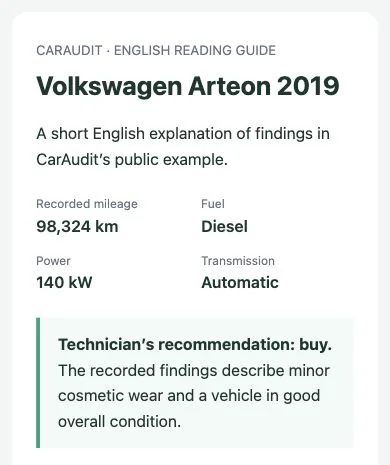
Editorial English reading guide to the official CarAudit sample report.
The original interface is English, and the technician’s notes are Spanish.
Who are you buying from, and what can be established about the car?
Match the vehicle identification number (VIN) with the advert, car and original documents. Ask for an invoice or sale contract, evidence of the seller’s identity and authority to sell, and the full chain of ownership and power of attorney where needed. Where financing or an intermediary is involved, it must be clear who is entitled to hand over the car. Agree the handover of originals and previously issued plates. 1 2
Maintenance and damage history helps identify questions, while physical findings show the car’s current condition. Mandatory roadworthiness testing, registration data and a pre-purchase inspection answer different questions. A clean registration record alone does not establish a complete history, ownership or a sound underbody. Ask for an original document explaining inconsistent mileage, body repairs or a maintenance gap, and compare it with what is seen on site. When enquiring about inspection possibilities, clarify whether the proposed scope allows assessment of the underbody and structural parts, leaks, tyres, brakes and running gear. A photo and explanation of a significant finding help you discuss with a workshop which repairs are needed before driving. 2
| Evidence | What do you decide? | Next step |
|---|---|---|
| Seller and VIN | Does the chain of ownership match the car? | Ask for a missing original or power of attorney before payment. |
| History and condition | Has damage or a maintenance gap been explained? | Compare documents with potential inspection findings and photos. |
| Proof of origin | Is there a basis for tariff preference? | Confirm the evidence and commodity code before export. |
| Customs-clearance plan | Will import take place at the border or in Estonia? | Appoint an organiser and, if needed, the transit office of destination. |
| Technical data | Can the chosen car be registered in Estonia? | Clarify the VIN data and required conformity check. |
If a Belgian car is also on your shortlist, the guide to buying a car in Belgium (Estonian) helps you compare checks on mileage and sale documents before making your final choice of purchase country.
The customs route: clearance at entry or transit to Estonia
For permanent export, the car must be declared for export at the competent Swiss customs office for commercial goods. The vehicle registration document is required even if cancelled, along with an identity document and the export declaration. The Swiss exporter must issue any proof of origin required for preferential duty before export. The purchase location and car brand do not replace demonstrated customs origin. 4
Before payment, agree the actual commodity code, applicable tariff, evidence and place of clearance with the customs representative. You can arrange import at EU entry or lawful common transit, with Union external transit where applicable, to a designated Estonian customs office. Switzerland participates in common transit. This suspends import-tax payment during the procedure rather than extinguishing the liability: the car must be presented at the designated office of destination and transit properly discharged. Retain evidence of discharge and release into free circulation. 4 6 1
If the car has already been lawfully released into free circulation in another member state, check that state’s clearance and tax documents. The same import is not charged Estonian import VAT a second time; however, the Estonian rate cannot automatically be applied to clearance in another country. The seller’s statement “customs cleared” needs documentary support. 6 22
Two taxable bases, one transparent budget
Customs value starts from the lawful transaction value, meaning the price actually paid or payable, and the additions required by law. These include relevant transport, insurance, loading and handling costs up to entry into the EU customs territory. Subsequent transport within the EU is not added to customs value simply because the final destination is in Estonia. If the transaction-value method is unsuitable, the next lawful valuation method must be used. 5
The Estonian import VAT base includes customs value, taxes due on import and relevant commission, packing, transport and insurance costs to the first Estonian destination that have not already been included. A cost already included in the price or customs value is not added again. For an import taxable in Estonia, 24% VAT applies to the correct base; this standard rate has applied since 1 July 2025. 13 14
Determining customs duty requires the actual tariff code, proof of origin and the basis for any exemption. Ask for the calculation to show customs value, customs duty, VAT base and VAT payable separately. Calculation bases are not extra invoices: the purchase price and transport appear only once in the actual cost budget. Driving the car home and a transporter are alternatives, and a tax base component is not added to the full calculated tax again. 5 13 4
| Cost or calculation item | Amount or input | Condition and basis |
|---|---|---|
| Registration-fee base | €150 | Base included within the total fee; an M1 car subject to the vehicle registration fee does not incur the general €150 administrative state fee. |
| Standard Estonian number plates | €65 | Separate plate charge. |
| Full-year annual-tax base | €50 | Base; the actual full-year tax and first-year portion are calculated separately. |
| Car purchase | To be determined | Invoice or contract and payment terms. |
| Trip to drive it home | To be determined | Dates, fuel, tolls, accommodation; alternative to a transporter. |
| Transporter | To be determined | Written quotation for the same route; alternative to driving it home. |
| Necessary repairs | To be determined | Workshop quotation based on identified defects. |
| Total registration fee | To be determined | VIN, carbon dioxide (CO2) measurement method, maximum mass, powertrain, age and seats; includes the base. |
| Actual full-year annual tax | To be determined | Vehicle data, age and tax calculation branch; includes the base. |
| First-year annual tax | To be determined | Actual annual rate and registration date; not in addition to full-year tax. |
| Estonian motor liability insurance | To be determined | Car, insurer and start of cover. |
| Customs value: calculation base | To be determined | Lawful transaction value and additions, including transport to EU entry; not an extra cost. |
| Customs duty | To be determined | Actual tariff, customs value, proof of origin and basis for exemption. |
| Import VAT | To be determined | 24% of the correct base only for an import taxable in Estonia; check the country of clearance. |
| Customs and transit arrangements | To be determined | Clearance, guarantee and customs representative’s quotation, including Swiss export. |
| Cantonal export plates and insurance | To be determined | Actual canton, car, validity and whole route; driving-home branch. |
| Individual inspection quotation | To be determined | First establish whether the specific Swiss car can be inspected, then scope, price and timing. |
Sources: 7 8 9 10 1 4 2 11 12 5 13 14 6 15
The right to drive depends on the canton and route
Export-number questions are handled by the competent Swiss cantonal registration authority. For the specific car, ask about required documents, applicant conditions, the start and end of validity, charges and insurance. Obtain the insurer’s confirmation for the entire chosen route and dates; a cantonal registration number alone does not establish the right to drive throughout the route. The customs export declaration is a separate procedure. 4
| Option | Required confirmation | Decision before departure |
|---|---|---|
| Driving it home | Cantonal documents, validity, charges, insurance for the entire route | Book travel after confirming the right to drive and customs route. |
| Carried on a transporter | Transport quotation, handover, originals and customs procedure | Choose if driving conditions remain unresolved or total transport cost is more suitable. |
| Customs route for either method | EU import clearance or transit to a designated Estonian customs office | Retain evidence of release or transit discharge. |
In the transporter’s quotation, agree practical arrangements for loading, the handover location, cargo protection and the movement of keys and originals. If the right or insurance needed to drive remains unconfirmed, compare carriage with the car loaded on a transporter. The transporter also needs a clear arrangement for the selected customs procedure and handover of documents. 4 6
If you are considering the same model in a nearer purchase market, the guide to bringing a car from Austria (Estonian) helps you compare practical arrangements for driving it home and using a transporter. To compare who handles export procedures and the handover of originals, use the guide to bringing a car from Czechia (Estonian).
In Estonia: from customs evidence to registration and taxes
Before registration, the car undergoes the Transport Administration’s pre-registration conformity check. A vehicle put into road use in Estonia must be registered within five working days of being put into use; this period does not authorise driving with expired registration, plates or insurance. Plan the check and documents before arrival. 1
Submit original acquisition documents and the chain of ownership, the foreign registration certificate including both parts if issued, an identity document or power of attorney, and customs-clearance evidence. A new car needs a Certificate of Conformity (CoC); this is not a universal requirement for a used car. Technical-data and type-approval requirements depend on the actual VIN and vehicle configuration. 1
At registration in Estonia, previously issued registration or transit plates must be handed to the Transport Administration (Transpordiamet); the handover is recorded in the register. Agree with the seller, before collection, how you will receive the plates and originals. Any Swiss return procedure must be coordinated separately with the competent canton and Estonian authority. 1 19
The registration fee is paid before the first Estonian register entry. It and the Tax and Customs Board’s annual motor vehicle tax have applied since 1 January 2025 and are separate obligations. An M1 passenger car subject to the vehicle registration fee does not incur the separate general €150 administrative registration state fee; €150 is the base component of the vehicle-specific registration fee. Standard Estonian number plates cost a separate €65. 20 7 8 9
Registration fee: choose the correct calculation branch
For an ordinary M1 car with up to seven seats, other than a battery-electric vehicle, the registration fee’s CO2 component depends on the measurement method. With a figure from the Worldwide Harmonised Light Vehicles Test Procedure (WLTP), grams are charged progressively: 1–117 at €5, 118–150 at €10, 151–200 at €30 and from gram 201 at €50 per gram. A figure from the earlier New European Driving Cycle (NEDC) uses a multiplier of 1.21. The mass component charges €2 per kilogram above 2000 kg, capped at €2000; the mass threshold for an externally chargeable plug-in hybrid is 2200 kg. 7
The age coefficient reduces components above the base, rather than the €150: the coefficient for a five-year-old car is 0.48. A battery-electric M1 car also has a €150 base; its mass component starts above 2400 kg, at €2 per kilogram with a €2200 cap. A missing CO2 figure, camper or car with more than seven seats requires a separate statutory calculation. 7
Annual tax and the first-year deadline
For an ordinary M1 car, €50 is only the full-year base. Applicable CO2 and mass components are added, and age is taken into account without reducing the base. The annual-tax age coefficient differs from the registration-fee coefficient: for a five-year-old car it is 0.92. Age is counted from first registration anywhere in the world. Battery-electric car and camper branches differ; from 2026, M1 cars with more than seven seats use the N1 van-category calculation. 10 23 11
First-year payment is calculated proportionately from the day after registration to the end of the year, using the actual registration date and car data. First registration from 1 January to 30 September 2026 makes annual tax due on 15 December 2026; registration from 1 October to 31 December 2026 makes it due on 15 June 2027. The tax notice is issued within 15 working days of registration. These annual-tax deadlines do not postpone payment of the registration fee before the register entry. 12 24 20
When do the EU new-car thresholds matter?
VAT on a direct Swiss import follows import rules even for a used car. Only in a separate, genuinely applicable intra-EU acquisition branch, after lawful release into free circulation and establishment of Union-goods status, should the acquisition rules be assessed. For VAT purposes, a car is new if supplied no more than six months after first use OR if mileage is no more than 6000 km; a used car must exceed both thresholds. Exactly 6000 km remains in the new-car branch. 22 25
An ordinary purchase of a used car from a private seller within the EU does not automatically create additional Estonian VAT. For a dealer, read the invoice’s actual ordinary or margin-scheme treatment. Declaration and payment for an intra-EU acquisition of a new means of transport taxable in Estonia must take place within ten calendar days of arrival and no later than registration. This deadline belongs to that separate acquisition branch; taxes on a direct Swiss import are dealt with during customs clearance. 25 22 14
Before the final decision
Link each payment to the next piece of evidence; resolve outstanding document and tax questions before sending the car on its way.
| Before the final decision | Your check |
|---|---|
| Before payment: match the VIN and authority to sell, and ask whether the specific car can be inspected. | To check |
| Before the contract: confirm origin evidence, the place of customs clearance and actual tax calculations. | To check |
| Before collection: confirm cantonal driving documents and insurance or a transporter, plus any necessary transit. | To check |
| In Estonia: submit customs and ownership evidence, hand over previous plates and arrange the check, taxes and registration. | To check |
Documents or conditions still need checking. Do not treat the file as complete.
Sources: 2 1 15 4 5 13 6 19 20 10
Is a car bought in Switzerland automatically free of customs duty?
No. Preference depends on actual customs origin, valid proof of origin and the commodity code. The Swiss exporter must issue the required proof before export. Confirm the tariff before purchase; the country of purchase alone does not establish preference. 4 5
Are customs value and the import VAT base the same?
They may differ. Customs value includes the required additions up to EU entry. The Estonian import base adds import taxes due and relevant costs to the first Estonian destination that have not already been included. The same cost is counted once. 5 13
Is 24% calculated only on the purchase price?
For an import taxable in Estonia, 24% applies to the full lawful import VAT base. Taking a percentage of the selling price alone leaves out possible customs duty and other costs belonging in the base. Import cleared in another country requires assessment of that country’s tax procedure. 13 14 6
Does transit mean tax exemption?
Transit suspends fulfilment of import obligations until proper discharge and clearance. Appoint the office of destination and organiser before transport. If the car was lawfully released in another member state, do not charge Estonian import VAT again on the same import. 6 1
Do cantonal export plates cover the whole journey?
Ask the competent canton for the specific car’s document, validity and charge requirements. The insurer must confirm cover for the entire route and driving dates. If the requirements are not evidenced, compare carriage on a transporter. 4
How do I ask CarAudit whether a Swiss car can be inspected?
Send the advert link, VIN, exact location and seller’s contact through the contact form. Ask whether inspection can be arranged and about its scope, photo and report output, price and timing. Switzerland is outside the usual 12-country offer; the next step depends on the individual response. 21 15
Which customs evidence and plates are needed in Estonia?
Retain import-release evidence and discharge evidence for any transit used, together with the chain of ownership and original foreign registration certificate. Previously issued registration or transit plates are handed to the Transport Administration at Estonian registration and the handover is recorded. Coordinate any cantonal return procedure separately. 1 19 6
To consider other purchase markets, find further topics on the news and guides page (Estonian).
Sources
- Sõiduki registreerimine | Transpordiamet
- Transpordiamet soovitab enne sõiduki ostmist teha põhjalik kontroll | Transpordiamet
- Mida kontrollime | CarAudit: kasutatud auto ülevaatus
- Vehicle Export from Switzerland
- Tolliväärtus | Maksu- ja Tolliamet
- Customs transit - Taxation and Customs Union - European Commission
- Liiklusseadus — Riigi Teataja
- Uuest aastast muutuvad sõiduki, maastikusõiduki ja haagise registreerimisega seotud riigilõivud | Transpordiamet
- Riigilõivud | Transpordiamet
- Maksumäärad ja maksu arvutamine — Maksu- ja Tolliamet
- Mootorsõidukimaksu seadus — Riigi Teataja
- Sõiduk registreeritakse liiklusregistris aasta jooksul — Maksu- ja Tolliamet
- Kaupade maksustamine | Maksu- ja Tolliamet
- Käibemaks | Maksu- ja Tolliamet
- Kontakt | CarAudit: kasutatud auto ülevaatus
- CarAudit sample — English reading guide
- CarAudit Tingimused | CarAudit
- Carvago.com | Online service - buying and selling used cars
- Mootorsõiduki ja selle haagise registreerimise tingimused ja kord — Riigi Teataja
- Mootorsõidukimaks | Transpordiamet
- CarAudit: ärge ostke kasutatud autot pimesi | 270 kontrollpunkti | Eesti
- Kui ostate uue või kasutatud sõiduki | Maksu- ja Tolliamet
- Sõiduki vanuse arvutamine — Maksu- ja Tolliamet
- Tasumise tähtpäevad 2026. aastal — Maksu- ja Tolliamet
- Value added tax (VAT) when buying or selling a car abroad — Your Europe