Check the Italian car’s ownership and condition before payment. Review export documents, the driving permit, transport options and Estonia’s registration fee and annual tax.
Before paying a deposit on an Italian car, check the right to sell, its actual condition and a lawful means of collection. Export deregistration normally takes place before the car is taken away. The registration document issued after deregistration does not authorise driving: to drive it yourself, you need a separate temporary permit, plates and insurance for the whole route. A vehicle transporter is the alternative. The official Italian export sources are in Italian. The linked Estonian authorities’ guidance and legislation, CarAudit reference pages and related import guides are in Estonian. 9 2 6
The English reading guide below introduces the sample report.
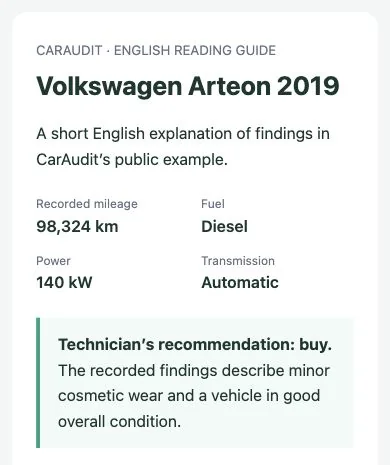
Editorial English reading guide; the original official report’s technician notes are Spanish.
Check the right to sell and current condition before payment
Compare the vehicle identification number or VIN on the car, documents and contract. Ask for the seller’s identity, chain of ownership, servicing and repair invoices, and a description of known damage. An extract from Italy’s vehicle ownership register, Pubblico Registro Automobilistico (PRA), helps check the registered owner and encumbrances. Visurenet costs €6; the computerised archive generally covers entries made after 1992. The extract is not an official certificate or a complete mileage history. 1 4
The online service uses supported digital identification. If you do not have a suitable credential, foreign applicants can use the provincial registry office’s application procedure. Ask for a current extract for the car. 1
An administrative hold, or fermo amministrativo, must be removed after the debt is paid. Attachment or seizure requires the creditor’s or competent authority’s consent; an unexpired registered mortgage requires the creditor’s consent in a notarised private deed. A seller’s promise to resolve the issue later does not meet these conditions. 2
| Check | What does it show? | Before payment |
|---|---|---|
| Register extract | Registered owner and encumbrances | Resolve the right to sell and releases. |
| Periodic inspection | Inspection validity and export branch | Check for an individual inspection order too. |
| Pre-purchase inspection | Current findings, photos and purchase recommendation | Obtain a quote for the work needed. |
The mandatory revisione, or periodic roadworthiness inspection, and a register extract answer different questions from a physical pre-purchase inspection. Findings and photos help decide whether to proceed with the purchase or request a repair quote. If you are still considering another origin country, compare your options with the guide to bringing a car from Austria to Estonia (Estonian) before committing to the purchase. 4
Export deregistration and documents
For definitive export, the car must be removed in the same procedure from both the national vehicle database, Archivio Nazionale dei Veicoli (ANV), and the ownership register explained above. This also applies when it is taken away on a vehicle transporter. The registered owner or another entitled person may apply; a buyer not yet entered as owner must present the original legally valid acquisition document. Agree an application appointment with the registry office. 9 3
On the application date, the periodic inspection must be valid, or the car must have passed the suitability inspection under Article 75 of the Highway Code in the year when the periodic inspection is due. There must also be no pending order for an individual inspection under Article 80(7). 2 3
Provide the number plate number, unified application, valid identity document, registration certificate and ownership certificate, Certificato di Proprietà (CdP), or the unified vehicle document, Documento Unico (DU), as well as the plates. If required documents or plates are lost or stolen, the prescribed report is needed. For representation, use a paper application signed by the buyer with authorisation and a copy of the representative’s identity document, or an administrative power of attorney signed by the buyer. Keep the complete chain of acquisition. 9 21
The unified vehicle document received on deregistration is marked as invalid for road use. Before collection, check which originals you will receive and which plates remain with the Italian authority. 9 2
If the car has already been registered abroad, the Italian automobile club also describes later deregistration using a copy of the foreign certificate; a statutory fine may apply. Attach the plates and road-use documents unless the foreign authority retained them. For those items retained by another European Union authority, no additional retention evidence is required; retention outside the Union requires the relevant declaration. A paper ownership certificate retained abroad separately requires the authority’s confirmation or a declaration, including within the Union; if lost, stolen or destroyed, a report or declaration that it was reported is needed. This is an exceptional retrospective solution. 2
Driving it yourself or using a vehicle transporter
For a car previously registered in Italy, the foglio di via, or temporary driving permit, requires prior export deregistration. The permit may be issued in the former registered owner’s name or in the buyer’s name with a declaration of ownership. An entitled applicant may also be an individual resident or a legal entity established outside Italy. However, an entitled person cannot apply for another beneficiary, including the buyer. 6
The application can be made to the Uffici Motorizzazione Civile (UMC), the vehicle authority’s office at the place of departure or another such office. Applicants with non-Union citizenship must account for the guidance’s additional lawful-stay and entry-document requirements; living in Estonia alone does not determine the citizenship branch. 6
The permit specifies the route, duration and technical conditions. 60 days is the statutory maximum, rather than a validity period issued to every car. The ministry’s guidance covers travel abroad with the correct document and temporary plate under the Vienna Convention’s conditions, but European Union temporary plates are not harmonised. Before booking, confirm the permit’s validity and insurance in every actual transit country and in Estonia. The European Union’s English-language purchase and transport guide helps check the temporary-plate question. 7 6 8
| Option | Necessary arrangements | Costs |
|---|---|---|
| Driving it yourself | Deregistration, temporary permit and plates; validity and insurance for the whole route. | Office fees, plates, insurance and travel. |
| Fully carried on a transporter | Export documents; recommended arrangements for loading and delivery locations, condition recording and protection of the load. | Written transport quote; the alternative of driving is not automatically added. |
The Carvago destination page here opens in Czech.
In Estonia: registration and VAT
An imported car put into use on Estonian roads must pass the pre-registration conformity check and be registered within five working days of being put into use, generally after import and customs clearance. This deadline does not extend expired plates, registration or insurance. 21
You need acquisition documents and the chain of ownership, the applicant’s identity document, authorisation when represented, and the original foreign registration documents, both parts if issued. The manufacturer’s Certificate of Conformity (CoC) is required for a new car, rather than automatically for every used car. Alterations, individual vehicle approval or missing technical data may require additional documents. 21
An Estonian citizen, a person with a residence permit or right of residence, or a legal entity or branch registered in Estonia can be entered as owner. For another owner, an eligible responsible user must be entered in the register. Previously issued registration or transit plates are handed over to Transpordiamet and their return is recorded. Since ordinary Italian plates are generally surrendered there on deregistration, coordinate the deregistration document, originals and temporary plates actually issued; the same plates cannot be handed to both authorities. 21 22 9
For VAT purposes, a car is used only where more than six months have passed since first registration and its mileage exceeds 6,000 km. No more than six months or no more than 6,000 km means a new car; equality at a threshold also belongs in the new branch. Buying a used car from a private seller within the Union does not automatically create additional Estonian VAT; when buying from a dealer, check the invoice’s ordinary or margin scheme. The European Union’s English-language VAT guide also explains the exact distinction. 17 16
Where Estonian standard VAT is due, the rate has been 24% since 1 July 2025. For an intra-Union acquisition that is new for VAT purposes, a private individual or non-VAT-registered person submits the purchase documents and pays within ten calendar days of delivery of the car to Estonia, and no later than registration. 16 23
Union goods moving from Italy to Estonia normally incur no customs duty. An Italian sale location alone does not prove customs status: for a third-country car not previously registered in the Union, ask for the customs-clearance declaration. Without proof, declaration, customs duty and import VAT may be required in Estonia. Technical conformity and customs status are separate questions. 16 17
Calculate the registration fee and annual tax separately
The registration fee and annual motor vehicle tax, in force since 1 January 2025, are separate obligations. The former is paid before first registration in Estonia. For an M1 passenger car subject to the vehicle registration fee, the general €150 administrative registration state fee is not added; standard Estonian plates cost €65. 24 12 13
For an ordinary M1 passenger car with up to seven seats, the registration fee comprises a €150 base, CO₂ and mass components. The Worldwide Harmonised Light Vehicle Test Procedure (WLTP) provides the CO₂ bands: grams 1–117 cost €5, 118–150 cost €10, 151–200 cost €30 and from the 201st gram €50 per gram. The bands apply progressively, rather than one rate to the entire figure. The mass component is €2 per kilogram of maximum permitted mass above 2,000 kg, capped at €2,000; the threshold for a plug-in hybrid is 2,200 kg. 11
Where only a New European Driving Cycle (NEDC) result is available, it is multiplied by 1.21 before the bands are applied. Where CO₂ is missing, round the reference figure: 0.29 × engine kW + 0.07 × unladen mass in kg + 4.92 × the car’s age when the fee is determined. Deduct 35 for a diesel, 52 for a diesel hybrid that cannot be charged externally, or 39 g/km for a petrol hybrid; the reference figure is capped at 350 g/km. For a plug-in hybrid with missing CO₂, use 46 g/km instead, with the base and relevant mass component. 11
A fully electric car has a €150 base and €2 per kilogram of maximum permitted mass above 2,400 kg, with the mass component capped at €2,200. A car with a motorhome body type or an M1 with more than seven seats uses N1 rates. 11
Registration-fee age is measured from first registration anywhere in the world to registration in Estonia or the first transfer of ownership. The coefficients for completed ages 1–20 years are, in order: 0.87; 0.75; 0.65; 0.56; 0.48; 0.42; 0.36; 0.31; 0.26; 0.22; 0.19; 0.16; 0.14; 0.12; 0.10; 0.09; 0.08; 0.07; 0.06; 0.05. Apply the coefficient to the amount excluding the base, and round the result to cents. 11
The full-year annual-tax base is €50. For a combustion-engine M1, the CO₂ bands are 118–150 grams at €3, the 151–200 portion at €3.50 and from the 201st gram €4 per gram. The mass component is €0.40 per kilogram above 2,000 kg, capped at €400; the plug-in hybrid threshold is 2,200 kg. The NEDC figure is multiplied by 1.21. Where CO₂ is missing, use the rounded reference formula, deductions and 350 g/km cap given above, but with age at the start of the annual-tax period. For a plug-in hybrid with missing CO₂, only the base and mass component remain, rather than the registration fee’s 46-gram branch. 14 25
Annual-tax age is counted from first registration anywhere in the world to the start of the tax period: as at 1 January for a car already in Estonia’s register, or as at the registration date in its first year of registration in Estonia. A full year is completed at the end of the anniversary date. The coefficients for the non-base portion at completed ages 5–15 years are: 0.92; 0.84; 0.75; 0.67; 0.59; 0.51; 0.43; 0.35; 0.26; 0.18; 0.10; at age 20, zero, while the base remains. A fully electric car’s full-year base is €50, with a mass component of €0.40 per kilogram above 2,400 kg, capped at €440. Motorhomes and M1 cars with more than seven seats use N1 annual rates, rather than registration-fee coefficients. 14 26
For first registration in Estonia during 2026, annual tax is calculated from the day after registration to the end of the year. For registration from January to September, payment is due on 15 December 2026; from October to December, on 15 June 2027. The tax notice is issued within 15 working days. 27 28 14
Budget before deciding to buy
| Cost | Amount or input | Condition |
|---|---|---|
| Italian register service fee | €13.50 | Export-deregistration component only. |
| Italian vehicle authority fees | €10.20 | Deregistration component; collection costs are extra. |
| Italian deregistration stamp duty | €32 | Third deregistration component. |
| Register extract | €6 | Selected extract of legal status. |
| Trento T004 fees | €10.20 | Only the stated local procedure/category. |
| Trento T004 stamp duty | €16 | Same conditional procedure; manufacturing and insurance separate. |
| Estonian registration-fee base | €150 | Base only within the total fee; a second general administrative state fee is not added. |
| Standard Estonian plates | €65 | Separate from the registration fee. |
| Estonian full-year annual-tax base | €50 | Vehicle components and first-year proportion separate. |
| CarAudit standard inspection | €289 | Car located in Italy; VAT and technician travel included. |
| Optional traction-battery diagnostics | €179 | Confirm compatibility with the electric or plug-in hybrid car. |
| Optional Cebia history report | €29 | Separate additional service. |
| Purchase price and possible VAT | To be determined | Contract, invoice, vehicle age/mileage and VAT scheme. |
| Total permit, plate and insurance costs | To be determined | Competent office, car, route, dates and insurer. |
| Trip to drive it home | To be determined | Travel to the car, fuel, tolls and accommodation. |
| Vehicle transporter | To be determined | Actual route, ability of the car to move and transport quote. |
| Intermediary and payment-collection costs | To be determined | Selected office or intermediary’s price list. |
| Necessary repairs | To be determined | Inspection findings and workshop quote. |
| Estonian vehicle-specific taxes | To be determined | Technical data, age and registration date; two separate calculations. |
Sources: 9 1 10 11 12 13 14 15 16 17 6 8 4
Italy’s three official deregistration components total €55.70, plus the relevant payment-collection costs. This is not the entire export or collection cost to Estonia. Trento’s temporary-plate guidance for the local T004 procedure separately shows €10.20 in fees and €16 stamp duty; its documents section is headed “In caso di radiazione per esportazione di autoveicoli, motoveicoli e rimorchi di massa complessiva uguale o superiore a 3,5 tonnellate”. Confirm the applicable category and office charge: €26.20 is not a universal Italian package. 9 10
Keep the decision manageable in four stages.
- Before a deposit: VIN, right to sell, encumbrances and current condition.
- Before deregistration: inspection branch, entitled applicant and originals.
- Before collection: valid driving permit, plates and whole-route insurance, or a transporter.
- In Estonia: conformity check, registration deadline, documents and plates; two separate tax calculations.
Sources: 1 2 4 9 3 6 8 21 22 11 14
If you are still choosing where to buy, the guide to bringing a car from Germany (Estonian) helps compare a separate purchase route. Other origin-country options are set out in the overview of import guides for Estonia (Estonian).
Frequently asked questions
Is a valid Italian roadworthiness inspection enough for the purchase decision?
No. The periodic inspection and export-deregistration requirements are separate from assessing the car’s current condition. Also check for a possible individual inspection order, and compare the car’s condition with the seller’s description and repair invoices. 2 3 4
Can I drive an export-deregistered car straight to Estonia?
The Documento Unico (DU) issued on deregistration is invalid for road use. Driving requires a separate foglio di via temporary driving permit, temporary plates, and permission and insurance throughout the route; having the car carried on a transporter is the alternative. 9 6 8
Is the temporary driving permit always valid for 60 days?
No. The foglio di via specifies the actual route, duration and technical conditions; 60 days is the upper limit. Before collection, confirm the actual permit and insurance in transit countries and Estonia too. 7 6 8
Can a buyer living outside Italy apply for the temporary driving permit?
An entitled person may apply without residence in Italy. Issue in the buyer’s name requires an ownership declaration and prior deregistration of a car previously registered in Italy. An entitled person cannot apply for another beneficiary; applicants with non-Union citizenship have an additional stay-document branch. 6
Does €55.70 cover the entire cost of bringing the car from Italy?
It is only the sum of three official deregistration fees: €13.50 + €10.20 + €32. Payment-collection costs, any intermediary, temporary plates, insurance and transport are additional according to the chosen arrangement. 9
When is a used car new for VAT purposes?
No more than six months since first registration or no more than 6,000 km means the vehicle is new for VAT purposes. To be used, it must exceed both thresholds. VAT payable in Estonia depends on the actual acquisition and accounting scheme. 17 16
Sources
- Visurenet: visura della banca dati del PRA
- Radiazione per esportazione: informazioni utili
- Art. 103 — Obblighi conseguenti alla cessazione della circolazione dei veicoli a motore e dei rimorchi
- Transpordiamet soovitab enne sõiduki ostmist teha põhjalik kontroll | Transpordiamet
- Mida kontrollime | CarAudit: kasutatud auto ülevaatus
- Art. 99 c.d.s. Rilascio dei fogli di via. Istruzioni applicative. Circolare 7518 del 3 marzo 2021
- Art. 99 — Foglio di via
- Buying and leasing a car in another EU country
- Radiazione di un veicolo: esportazione all’estero
- Rilascio targa provvisoria e foglio di via
- Liiklusseadus — Riigi Teataja
- Uuest aastast muutuvad sõiduki, maastikusõiduki ja haagise registreerimisega seotud riigilõivud | Transpordiamet
- Riigilõivud | Transpordiamet
- Mootorsõidukimaksu seadus — Riigi Teataja
- CarAudit: ärge ostke kasutatud autot pimesi | 270 kontrollpunkti | Eesti
- Kui ostate uue või kasutatud sõiduki | Maksu- ja Tolliamet
- Value added tax (VAT) when buying or selling a car abroad — Your Europe
- CarAudit — tellige ülevaatus
- CarAudit Tingimused | CarAudit
- Carvago.com | Online služba pro nákup a prodej ojetých vozů
- Sõiduki registreerimine | Transpordiamet
- Mootorsõiduki ja selle haagise registreerimise tingimused ja kord — Riigi Teataja
- Käibemaks | Maksu- ja Tolliamet
- Mootorsõidukimaks | Transpordiamet
- Maksumäärad ja maksu arvutamine — Maksu- ja Tolliamet
- Sõiduki vanuse arvutamine — Maksu- ja Tolliamet
- Sõiduk registreeritakse liiklusregistris aasta jooksul — Maksu- ja Tolliamet
- Tasumise tähtpäevad 2026. aastal — Maksu- ja Tolliamet