Before travelling to Germany to collect a car, ask the seller to explain how you will be able to drive that particular car to Estonia.
Before travelling to Germany to collect a car, ask the seller to explain how you will be able to drive that particular car to Estonia. The answer must cover the vehicle documents, a valid HU where required, appropriate export registration and insurance. The car’s technical condition needs a separate assessment: the seller’s promise that it is “ready to drive away” is no substitute for evidence. This guide helps you decide when to proceed with the purchase, when to choose a carrier and when to stop the transaction. Export plate requirements; recommendation for a pre-purchase inspection.
Start with the seller, VIN and complete documentation
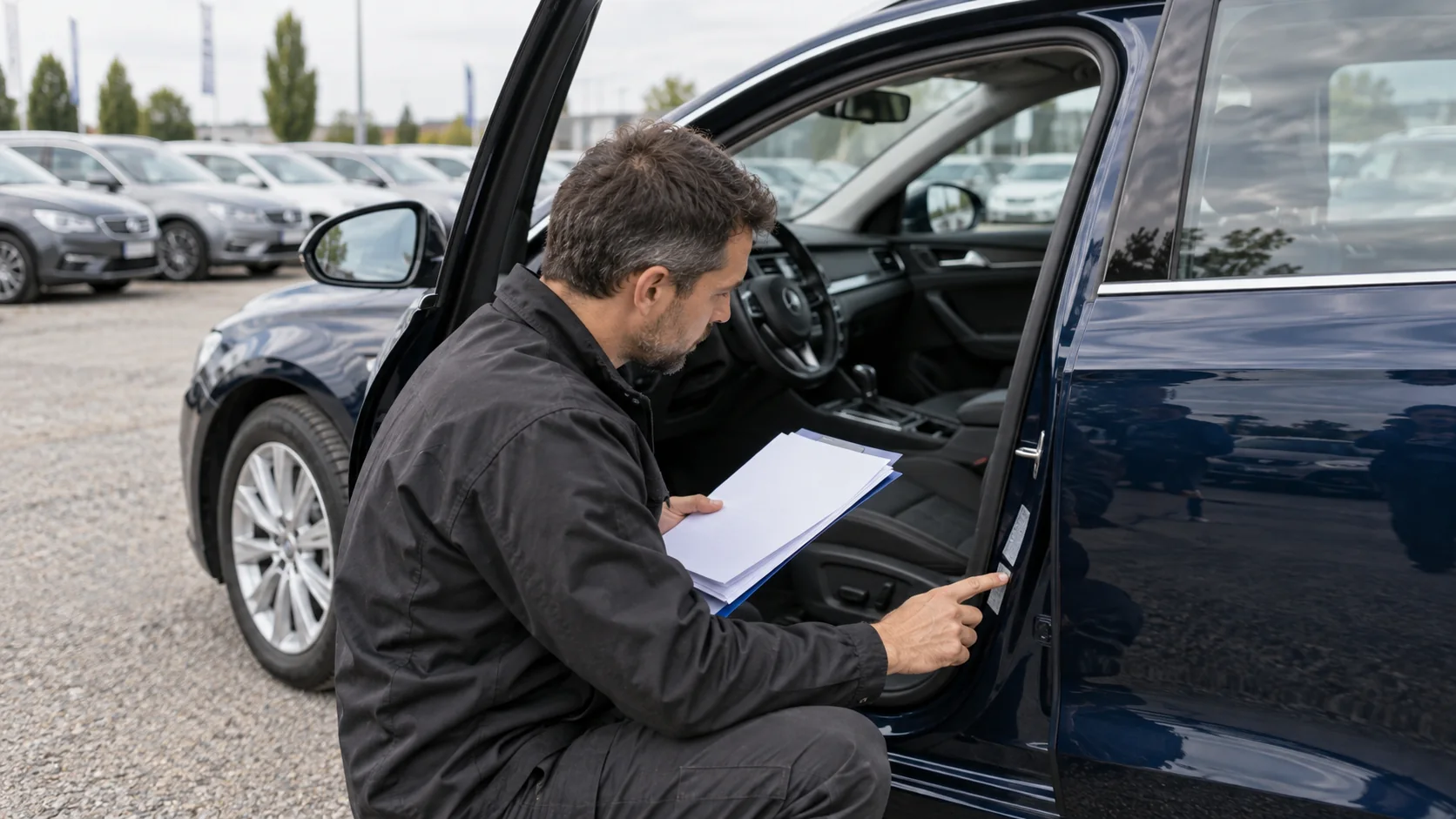
Before paying a non-refundable deposit, ask for the VIN, copies of both parts of the registration certificate, proof of HU and a draft purchase agreement or invoice. The German registration certificate has two parts: Teil I and Teil II. Compare the VIN on the documents with the one on the car, and establish who has the right to sell the vehicle. If the seller is acting on someone else’s behalf, ask for authorisation and documents explaining the transfer of ownership. Different names do not in themselves prove fraud, but the connection between them must be clear. Documents for registration; checks before purchase.
Ask for servicing invoices and any available evidence of damage or repairs. Put the documents in chronological order: are there inconsistencies between the mileage, servicing and the seller’s explanations? Treat a missing invoice as missing evidence, not automatic confirmation that servicing was skipped. Equally, a clear history check does not prove that the car is in good condition now. Transpordiamet’s buying advice.
Copies are suitable for an initial assessment, but for registration in Estonia, keep the used car’s original registration certificate, including both parts if issued, and the chain of documents proving ownership. Before transferring any money, agree which originals you will receive at handover. If an important document is “coming later”, resolve how you will obtain it before making a final commitment. Evidence required for registration.
Berlin: Ausfuhrkennzeichen Transpordiamet: thorough check before buying Transpordiamet: registration
A valid HU and suitability for purchase are separate questions
HU is Germany’s periodic roadworthiness inspection. A valid HU, where required, is one of the conditions for obtaining export plates, but roadworthiness inspections, history data and independent pre-purchase inspections serve different purposes. A recent roadworthiness inspection does not establish that every issue affecting the purchase price or repairs in the near future has been assessed. HU in the export procedure; the need for a thorough inspection.
Prepare a specific list of questions for the inspector. Ask them to assess cold starting, visible fluid leaks, uneven tyre wear, the condition of the brakes and suspension, and, where possible, damage to the underside and structural components. For the bodywork, ask them to look for signs of previous repairs and compare the findings with the seller’s explanation. During a test drive, pay attention to gearbox operation, vibration and unusual noises; inside the car, check how the air conditioning, controls and warning lights behave. The overall purpose of the inspection is to assess the car’s actual condition before committing to buy. Pre-purchase inspection.
Also ask for the report to identify anything that could not be inspected. If access underneath the car is unavailable or a test drive does not take place, consider whether that missing information prevents you from making a purchase decision. For an electric car, separately confirm whether the additional battery inspection is suitable; unrestricted battery condition testing cannot be promised for every car, nor can access to a lift at every sales location. CarAudit’s service and terms.
CarAudit EE: current public offer, directly read in browser Berlin: Ausfuhrkennzeichen Transpordiamet: thorough check before buying
Arrange Ausfuhrkennzeichen before driving home
If you are bringing the car back by driving it yourself, arrange the appropriate export plates, or Ausfuhrkennzeichen, in Germany. This requires export insurance, the vehicle documents, a valid HU where required and arrangements for vehicle tax. Ask the seller or the relevant registration authority who will carry out the formalities and which documents and local procedural requirements apply to you. Do not plan your departure solely on the seller’s assurance that “you can get the plates here”. Berlin’s official export plate guidance.
Before departure, check that the registration and insurance are valid and suitable for the entire planned route. The expiry date on German domestic short-term plates does not, on its own, establish that you may drive through every country on the way to Estonia. Ask for explicit confirmation covering your intended use and carry the relevant documents with you on the journey. The procedure intended for export.
According to the sources as at 4 October 2026, Berlin’s administrative charge for export registration starts at EUR 33.20. Plate manufacture, insurance and vehicle tax are additional. Use this only as a Berlin reference point: it is neither a standard price across Germany nor the total cost of a complete export package. Obtain an actual quote for the planned procedure where the car is located. Berlin’s charge and additional costs.
Choose between driving and car transport before buying your ticket
If you plan to drive, budget for export formalities, insurance, taxes, travel to collect the car, fuel or charging and, if necessary, overnight accommodation. By contrast, ask a carrier for a written quote based on the specific VIN, collection point and destination in Estonia, together with an agreement on handover. These are two alternative plans for bringing the car home: do not add a complete car transport quote and a complete driving-home budget together as one unavoidable cost.
A practical decision point arises if the inspection leaves safe driving unresolved or the export registration arrangements are unclear. In that situation, I recommend postponing departure and exploring repair or car transport options. Choosing a carrier does not resolve missing proof of ownership or improve an unchecked purchase. The condition assessment, purchase documents and legal arrangements for driving each need to be addressed separately. Inspection principles; required documents; export registration.
Berlin: Ausfuhrkennzeichen Transpordiamet: thorough check before buying Transpordiamet: registration
In Estonia, count the registration deadline from putting the car into use
An imported car that is to be put into road use in Estonia must pass a pre-registration conformity inspection. The car must be registered within five working days of being put into use in Estonia. The deadline does not start simply when the car arrives in Estonia. Nor do those five working days give you permission to drive without valid registration or insurance. Plan the inspection and registration procedures before using the car on the road. Transpordiamet’s registration guidance.
Prepare the purchase agreement or invoice, evidence of the transfer of ownership, the original parts of the registration certificate, an identity document and, if using a representative, proof of their authority. Use the car’s exact VIN to confirm whether the technical data and type-approval information are sufficient. A certificate of conformity, or CoC, is required for a new car, but cannot be described as universally mandatory for every used car. Do not leave missing technical information to be addressed for the first time at an inspection centre in Estonia. Documentation and conformity requirements.
Distinguish between three procedures here: the German HU, the pre-purchase condition assessment and Estonia’s pre-registration inspection. Each helps answer its own question; having one document does not mean that all the remaining purchase and registration work has been completed. The role of a purchase inspection; the Estonian registration procedure.
Berlin: Ausfuhrkennzeichen Transpordiamet: thorough check before buying Transpordiamet: registration
For VAT, both age and mileage count
For VAT purposes, a car is used only if more than six months have passed since first use AND its mileage exceeds 6,000 km. A car is new for VAT purposes if it is supplied within six months of first use OR its mileage is no more than 6,000 km. Exactly 6,000 km also falls within the new-car threshold. For example, an eight-month-old car that has covered 6,000 km is still new in this sense. The word “used” in an advert does not determine the tax treatment. EU thresholds for new and used cars.
A used car bought in Germany does not automatically attract a further Estonian VAT charge for a private buyer in Estonia. A purchase from a private individual must be distinguished from the standard or margin treatment used on a dealer’s invoice; ask for the final invoice and an explanation of the tax treatment before paying. Where Estonian standard-rate VAT is due, the rate is 24%. A car acquired from the EU that is new for VAT purposes must be declared and the VAT paid within ten calendar days of arrival in Estonia, but no later than registration. EMTA’s buying guidance; VAT rate.
Bringing Union goods from Germany to Estonia generally does not attract customs duty. However, a German sales location alone does not prove that a car originating from a third country has previously cleared customs. If this question arises, ask for documents proving release for free circulation before buying. EU purchases and customs; taxation of cars from third countries.
Swiss customs: exporting vehicles EMTA: buying a vehicle abroad EMTA: standard VAT rate Your Europe: VAT on buying and selling cars
The registration fee is not the same as the annual tax
According to the sources as at 4 October 2026, the registration fee for an ordinary M1 car with up to seven seats consists of a EUR 150 base amount and the relevant CO₂ and maximum permitted mass components. The age coefficient applies to the components other than the base. Maximum permitted mass means the greatest mass allowed, not kerb mass. To establish the final amount, you need the specific car’s data and an official calculation. Registration fee rules in the Traffic Act.
In the WLTP calculation for an ordinary M1 car, excluding a fully electric car, CO₂ grams in the bands 1–117, 118–150, 151–200 and from 201 upwards cost EUR 5, 10, 30 and 50 per gram respectively. The bands apply progressively, rather than charging the entire figure at the highest applicable band’s rate. Above a maximum permitted mass of 2,000 kg, EUR 2 is added per kilogram, with the mass component capped at EUR 2,000; the mass threshold for a plug-in hybrid starts at 2,200 kg. An NEDC figure is multiplied by 1.21. The age coefficient of 0.48 for a five-year-old car affects the components other than the base. Calculation bands and exceptions.
For a fully electric car, the base is EUR 150, with a mass component of EUR 2 per kilogram above a maximum permitted mass of 2,400 kg, capped at EUR 2,200. Apply the separate rules for cars with no CO₂ figure and for special vehicle types. Do not transfer another car’s calculation to your own purchase. Rules for electric cars and special cases.
The annual vehicle tax has a EUR 50 base, plus the relevant CO₂ and mass components, with an age adjustment applying outside the base. On first registration during the year, the tax is calculated proportionately from the day after registration to the end of the year. You pay the registration fee before the first registration in Estonia; EMTA administers the annual tax separately. Annual tax calculation; first-year proportion; the difference between the two charges.
EMTA: annual tax rates and calculation EMTA: vehicle registered during the year Current Estonian Traffic Act, §§19019,19022,19024 Transpordiamet: motor vehicle tax
Make the final purchase decision using the report and a complete budget
CarAudit offers pre-purchase inspections in Germany. Its published standard price as at 4 October 2026 is EUR 289 including VAT and the technician’s travel costs, and the inspection covers up to 270 points. The report is ready within 48 hours after the inspection; weekends and public holidays are excluded from that calculation. This period does not begin when the order is placed. The optional additional battery inspection costs EUR 179 where the particular vehicle supports it. CarAudit’s offer.
Before ordering, confirm the VIN, the car’s location, the inspection appointment, the seller’s consent and access, and whether the inspection is suitable for the car. See what we inspect and frequently asked questions. Use the report to decide which findings need a repair quote and whether the seller’s answers resolve outstanding questions. The service is a pre-purchase inspection: transport, customs clearance and registration need their own arrangements, and the report does not guarantee the car’s future condition. Scope of the service.
CarAudit EE: current public offer, directly read in browser Transpordiamet: thorough check before buying
Budget for buying in Germany: published charges as at 4 October 2026, with variable costs based on a specific quote
| Cost | Amount or calculation basis | What to confirm before buying |
|---|---|---|
| Purchase price | The seller’s final invoice or agreement. | VAT treatment and all conditions attached to the price. EMTA EMTA: buying a vehicle abroad Your Europe: VAT on buying and selling cars |
| Pre-purchase inspection | EUR 289 including VAT and the technician’s travel; optional additional battery inspection EUR 179. | VIN, location, access and whether the battery can be tested. CarAudit CarAudit EE: current public offer, directly read in browser Transpordiamet: thorough check before buying |
| Export formalities when driving the car yourself | Berlin administrative charge of at least EUR 33.20; plate manufacture, insurance and vehicle tax are separate. | The local authority’s requirements and a quote. Berlin guidance Berlin: Ausfuhrkennzeichen |
| Bringing the car home: choose one option | Travel costs for driving it yourself OR a carrier’s quote; there is no universal amount. | Ask the carrier for a quote using the VIN and both addresses; if driving yourself, check the export arrangements. Requirements for driving Berlin: Ausfuhrkennzeichen |
| Estonian registration fee | EUR 150 base + vehicle-specific components and coefficients. | Enter CO₂, measurement method, maximum permitted mass, powertrain and age into the official calculation. Traffic Act Current Estonian Traffic Act, §§19019,19022,19024 |
| Standard Estonian number plates | EUR 65; for an M1 subject to the registration fee described here, the separate general EUR 150 administrative registration state fee is not added. | Do not count the EUR 150 a second time. State fee exception; plate charge Transpordiamet: state fees and registration fee interaction Transpordiamet: current state fee table |
| Annual vehicle tax | EUR 50 base + vehicle components; the first year is proportionate. | Vehicle data and the date of registration in Estonia. Rates; first year EMTA: annual tax rates and calculation EMTA: vehicle registered during the year |
| Estonian VAT, where applicable | 24% where Estonian standard-rate VAT is due; it is not automatically added to a used-car purchase from the EU. | Age, mileage and invoice treatment. Buying a car; rate EMTA: buying a vehicle abroad EMTA: standard VAT rate Your Europe: VAT on buying and selling cars |
| Customs duty | Generally none for Union goods moving within the EU. | Evidence of previous customs clearance where necessary. EU rules; EMTA Swiss customs: exporting vehicles EMTA: buying a vehicle abroad Your Europe: VAT on buying and selling cars |
| Repairs before use | A workshop quote based on the inspection findings. | Ask for the scope and price of the work; do not assume a universal repair allowance. Condition inspection Transpordiamet: thorough check before buying |
Checklist: evidence, next action and a reason to stop the purchase or journey
| Evidence | Action | Reason to stop | Your check |
|---|---|---|---|
| VIN and right to sell. Purchase inspection | Compare the car, documents and the seller’s authorisation. | A VIN discrepancy or an unexplained right to sell. Transpordiamet: thorough check before buying | To check |
| Teil I, Teil II and purchase documents. Registration | Agree on handover of the originals. | An important original is missing or the ownership chain is broken. Transpordiamet: registration | To check |
| HU and condition report. HU; purchase inspection | Distinguish the roadworthiness inspection from the assessment needed for the purchase. | Unresolved driving safety or an important item left uninspected. Berlin: Ausfuhrkennzeichen Transpordiamet: thorough check before buying | To check |
| Export registration and insurance. Export requirements | Confirm suitability for the entire route. | Relying only on the expiry date of short-term plates. Berlin: Ausfuhrkennzeichen | To check |
| Date of first use, km and invoice. VAT thresholds | Determine new or used status under the tax rules. | The tax treatment or final price remains unresolved. EMTA: buying a vehicle abroad Your Europe: VAT on buying and selling cars | To check |
| Estonian inspection and the car’s technical data. Procedure; fee calculation | Plan registration and calculate the charges. | Documents, the deadline or the budget remain unresolved. Current Estonian Traffic Act, §§19019,19022,19024 Transpordiamet: registration | To check |
Documents or conditions still need checking. Do not treat the file as complete.
Does a German car with a recent HU need a pre-purchase inspection?
A condition assessment is worthwhile for the purchase decision even with a valid HU. HU serves as the periodic roadworthiness inspection; it does not replace checks on the seller’s authority, repair evidence or findings relevant to the purchase. Ask for the report to include both findings and items that could not be inspected, and use them to make your decision. Checks before buying; HU for export.
Berlin: Ausfuhrkennzeichen Transpordiamet: thorough check before buying
Does EUR 33.20 cover German export plates and insurance?
No. According to the sources as at 4 October 2026, EUR 33.20 is the minimum administrative charge for export registration in Berlin. Plate manufacture, insurance and vehicle tax are additional. Elsewhere, ask for the cost of the local procedure and compare the individual items in the quote. Berlin’s official price information.
Can I drive to Estonia if the temporary plates have not yet expired?
The date alone is not enough. You need registration and insurance suitable for the route, along with the relevant vehicle documents. The validity of German domestic short-term plates does not automatically establish permission to drive all the way to Estonia. Confirm suitability before departure; if the issue remains unresolved, arrange transport. Ausfuhrkennzeichen procedure.
The car is eight months old and has covered exactly 6,000 km: will Estonian VAT be added?
Such a car is new for VAT purposes because its mileage does not exceed 6,000 km. When acquiring a new car from the EU, you must account for the Estonian VAT liability; the standard rate is 24%. Declaration and payment must take place within ten calendar days of arrival and no later than registration. Clarify the treatment of the German invoice before paying. Exact thresholds; deadline; rate.
EMTA: buying a vehicle abroad EMTA: standard VAT rate Your Europe: VAT on buying and selling cars
Is a CoC always required for a used car from Germany?
A CoC is not universally required for every used car; it is required for a new car. For a used car, use the VIN to check whether the technical data and type-approval information are sufficient, and retain the original parts of the registration certificate. Resolve any missing data before buying. Transpordiamet’s document requirements.
When do Estonia’s five working days start, and will the inspection report arrive in time?
The five-working-day registration deadline is counted from putting the car into use in Estonia. CarAudit’s report timing is a separate service term: 48 hours after the inspection, excluding weekends and public holidays. Plan the pre-purchase inspection before the final purchase decision, rather than within that registration period; placing the order does not start the report deadline. Estonia’s registration deadline; report terms.
CarAudit EE: current public offer, directly read in browser Transpordiamet: registration
Send the German car’s VIN and location and ask about arranging a pre-purchase inspection.